Bridging the Gap: How STEM Education Fuels Achievements in Sustainable Development Goals
Innovating for a Better Tomorrow: The Role of STEM in Advancing Sustainable Development
Introduction
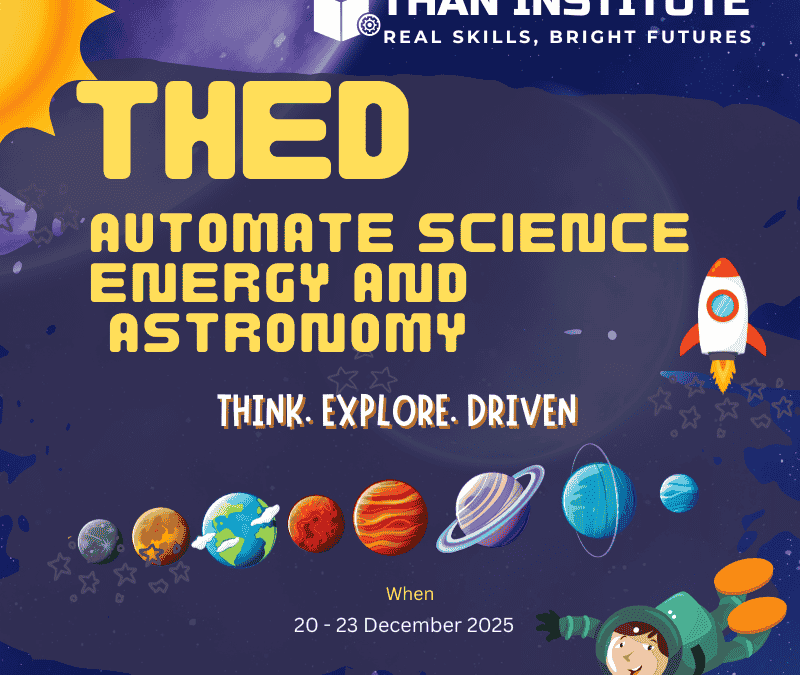
In a world where ideas move fast and tools grow smarter, ThED Automate 2025 invites curious minds to turn imagination into action. Hosted by the THAN Institute, this four-day experience blends automation with hands-on discovery in science, energy, and astronomy. The program welcomes learners who want to build, test, and improve prototypes while learning how data, sensors, and code can power better decisions. You will explore how robots gather results in labs, how smart systems optimize renewable energy, and how telescopes track the night sky with precision. Each activity is practical, collaborative, and purpose-driven to help you connect class concepts to real challenges. Expect clear tasks, simple steps, supportive mentors, and a culture that rewards curiosity and iteration.
- Gain confidence using automation to design and test ideas.
- Practice data collection, analysis, and presentation with real tools.
- Work in teams and learn leadership, communication, and planning.
- Build a project portfolio that demonstrates STEM skills.
What is ThED Automate 2025?
ThED stands for Think. Explore. Driven., and the 2025 edition focuses on using automation to make experiments repeatable, energy systems efficient, and sky observations reliable. Rather than a passive fair, ThED Automate functions like a mini innovation lab where you define a problem, map a solution, build a model, and demonstrate results. Students can join tracks in Science Automation, Smart Energy, or Space & Observation, yet teams are free to blend themes. Mentors guide you through sensors, microcontrollers, tracking software, and basic AI so your ideas are testable and measurable. The event ends with a public showcase that highlights prototypes, data stories, and lessons learned, helping you communicate impact with clarity and confidence.
- Structured tracks with flexibility for cross-discipline projects.
- Mentor hours, office hours, and feedback loops for fast progress.
- Showcase day with certification from THAN Institute.
- On-campus and virtual sessions for broad access.
| Focus Area | Goal | Learning Outcome |
|---|---|---|
| Science | Automate experiments and logging | Clean data, repeatable tests, clear conclusions |
| Energy | Design smart renewable systems | Efficient control, monitoring, and optimization |
| Astronomy | Program tracking and sky analytics | Accurate observation and event detection |
The Vision: Science, Energy, and Astronomy United
The vision behind ThED Automate is simple: when students connect fields, they learn faster and build better solutions. Automated science lowers error and speeds feedback, which helps teams move from guesswork to evidence. In energy, sensors and control logic keep systems safe and efficient, while dashboards make performance easy to read. For astronomy, automation allows telescopes to capture more events with less manual effort and to share logs for later study. These elements create a full loop: observe, record, analyze, and improve. The result is a mindset that sees technology as a helper that saves time, reduces waste, and frees people to focus on creative problem solving.
- Bridge disciplines with a practical, project-first approach.
- Use data to make simple, transparent decisions.
- Practice sustainable design with measurable outcomes.
- Develop a growth mindset that welcomes testing and iteration.
Why Automation Matters in Modern Learning
Automation matters because it turns complex tasks into simple routines that students can repeat, compare, and improve. When a sensor logs temperature every minute, you do not guess; you see a curve and act on facts. When a tracker aligns a telescope, you spend time exploring rather than troubleshooting. And when a controller manages solar input and storage, you learn how energy moves and where it is lost. These habits create literacy in systems thinking and make learning active, fair, and inclusive. Clear steps, short cycles, and visible results help every student participate and share progress with ease.
- Move from theory to practice with small, safe experiments.
- Collect better data for stronger reports and talks.
- Reuse code and hardware modules to save time and reduce cost.
- Build confidence with visible improvements in each run.
Key Features and Event Highlights
Across four focused days, you will join labs, challenges, and talks that keep you engaged and productive. Automation & Robotics Labs introduce microcontrollers, simple AI, and mechanical design. Astronomy Challenges show how to script constellation tracking and how to plan a safe observing session. Energy Hackathons focus on solar, storage, and smart control with simple dashboards. Expert Panels bring voices from research and industry to share practical tips for projects and careers. The Innovation Showcase lets you present results with clarity, including goals, method, data, and the next step you would test with more time.
- Hands-on labs for robotics, data logging, and control.
- Night-sky sessions and virtual sky simulators for astronomy.
- Renewable energy design sprints using sensors and IoT.
- Mentor feedback, certification, and portfolio-ready artifacts.
| Event Type | Duration | Skill Focus |
|---|---|---|
| Automation Lab | 2 hours | Robotics, AI basics, sensors |
| Astronomy Night | 3 hours | Telescope tracking, sky scripting |
| Energy Hackathon | 4 hours | Renewables, control, dashboards |
Benefits for Students and Educators
Participants leave with practical skills, a clear story of their work, and a stronger sense of purpose. Students practice teamwork and communication while learning to scope tasks, track progress, and present results. Educators gain classroom ideas, templates, and simple modules that make labs safer and easier to repeat. Everyone benefits from a shared vocabulary that blends science method, energy literacy, and astronomy observation with basic coding habits. The approach is inclusive and supportive, with small steps and fast feedback to help every learner grow. These habits transfer to future courses, internships, and community projects.
- Students: Build prototypes, collect data, and present impact.
- Educators: Bring home ready-to-run lesson patterns and rubrics.
- Schools: Showcase a culture of innovation with measurable results.
- Parents: See growth in confidence, clarity, and curiosity.
Comparison Tables
Traditional Learning vs ThED Automate
| Aspect | Traditional Classroom | ThED Automate Experience |
|---|---|---|
| Learning Mode | Theory & Worksheets | Projects, automation, and demos |
| Engagement | Passive | Active, team-based, iterative |
| Skills | Subject recall | Coding, systems thinking, communication |
| Outcome | Grades | Prototypes, data stories, certifications |
Engagement Level (Low · Normal · High)
| Level | Student Activity | Automation Use | Evidence Collected |
|---|---|---|---|
| Low | Watching demos | Prebuilt only | Photos and short notes |
| Normal | Guided builds | Simple sensors & scripts | Tables, basic charts |
| High | Independent teams | Custom logic & dashboards | Repeatable trials, clear metrics |
How to Participate
Dates: 20–23 December 2025 | Venue: THAN Institute (On-Campus & Virtual) | Eligibility: Ages 10–18, individuals or school teams
- Visit: www.thaninstitute.com
- Register for your preferred track: Science Automation Smart Energy Space & Observation
- Prepare a simple idea, gather materials, and join orientation.
- Build, test, present, and celebrate what you learned.
Conclusion
ThED Automate 2025 turns learning into action with simple tools, kind guidance, and a focus on results. By blending science, energy, and astronomy, the event shows how automation helps people work smarter and learn faster. You will leave with a story you can tell, a prototype you can improve, and a plan for what you want to build next. Join us to think with clarity, explore with purpose, and stay driven by data and curiosity. The future needs builders who learn by doing; we are excited to see what you create.
Suggested Sources