
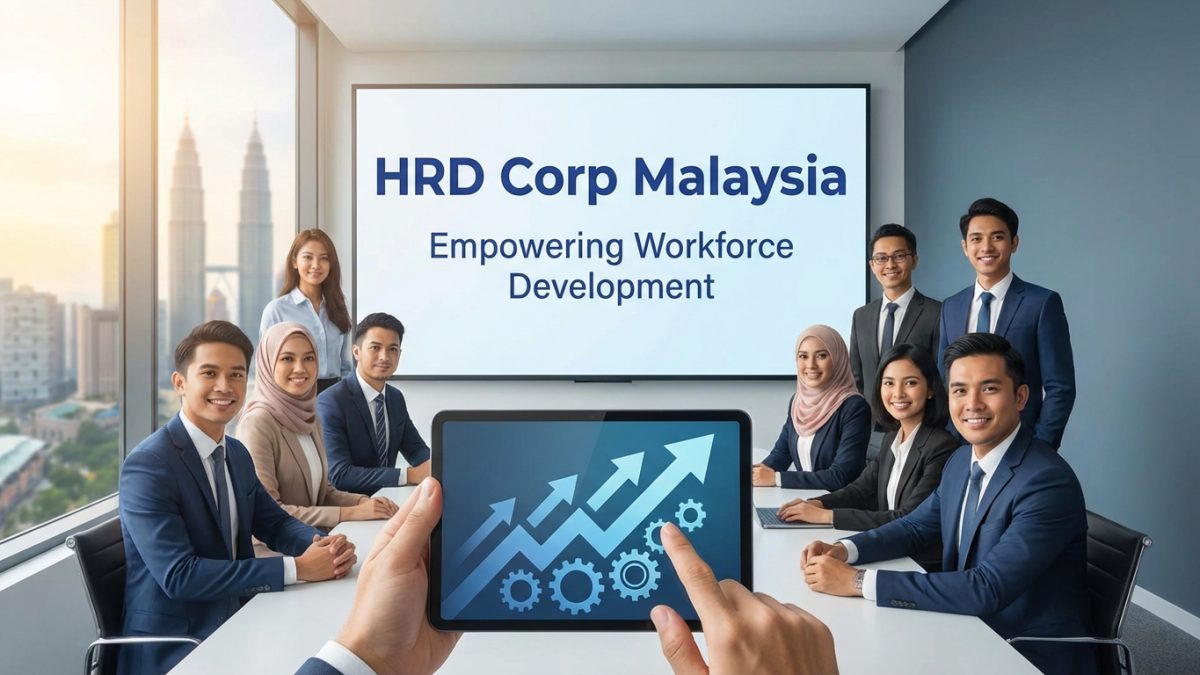
HRD Corp Malaysia: Empowering Workforce Development

HRD Corp Malaysia Training and Grants
Artificial intelligence (AI) in the workplace refers to the use of machine learning, natural language processing, and automation tools to augment human work, streamline processes, and generate data-driven decisions. In practical terms, AI helps teams analyze large datasets, automate repetitive tasks, improve customer experiences, and forecast outcomes with higher accuracy than manual methods. It matters because organizations across Malaysia are racing to increase productivity, reduce costs, and reskill talent for the digital economy; AI is the keystone technology that makes this transformation achievable and measurable. The beneficiaries are wide-ranging: business leaders seeking competitive advantage, HR and L&D teams building HRDC claimable training roadmaps, operational managers aiming for efficiency, and employees who want to elevate their roles from routine work to higher-value problem solving. For HRDC-focused organizations, AI adoption is not just a technology project; it is a structured capability-building journey that links skills development, governance, and ROI to Malaysia’s national upskilling agenda. Done well, AI enables safe, ethical, and compliant innovation that respects PDPA requirements while delivering tangible business results. This article explains the Who, What, When, Where, Why, and How—complete with benefits, examples, a maturity comparison table, and an implementation playbook.
- Definition
- Benefits
- Who Should Adopt
- When and Where to Implement
- How to Implement
- Comparison: Low vs Moderate vs High Maturity
- Use Cases and Examples
- Compliance, Risk, and Governance in Malaysia
- FAQs
- Conclusion

Definition
“AI in the workplace” encompasses software and systems that learn from data to make predictions, generate content, recognize patterns, and automate actions. Typical components include machine learning for predictive analytics, natural language processing for chatbots and summarization, computer vision for quality control, and robotic process automation (RPA) for rule-based workflows. In a corporate training context, AI also includes adaptive learning platforms that personalize content and coaching to employee needs, accelerating capability building for HRDC-funded programs. The goal is not to replace people but to elevate them—freeing employees from repetitive work so they can focus on customers, creativity, and continuous improvement. Success relies on high-quality data, clear business objectives, and governance that aligns with legal and ethical standards like PDPA and reputable risk frameworks. When paired with change management and measurable KPIs, AI becomes a sustainable driver of digital transformation rather than a one-off pilot.
Benefits
Organizations often ask why AI deserves priority in a crowded transformation agenda. The answer: AI links directly to measurable value—time saved, costs avoided, risks reduced, and revenues increased through better decisions and experiences. It also supports talent development by embedding data literacy, critical thinking, and problem-solving into daily work. For HR and L&D leaders, AI-enabled learning analytics reveal skills gaps and training impact, making HRDC claims more strategic and evidence-based. From a leadership perspective, AI enables faster planning cycles and scenario modeling, improving agility in uncertain markets. And for compliance and governance teams, AI can automate parts of monitoring, reporting, and document control, reducing manual burden while improving audit readiness. Below are detailed benefits your team can realize.
- Productivity and cost efficiency: Automate high-volume, rules-based tasks (e.g., invoice processing, document classification, customer email triage), cutting cycle times by 30–60% while reducing error rates and rework.
- Better decisions with predictive analytics: Forecast demand, churn, and cash flow; prioritize leads; and optimize staffing with data-driven models that outperform guesswork and static spreadsheets.
- Enhanced customer experience: Deploy AI chatbots and semantic search to answer FAQs instantly, route complex cases to specialists, and provide 24/7 support without expanding headcount.
- Talent development and learning impact: Use adaptive learning, skill profiling, and content recommendations to personalize HRDC-funded training paths, increasing completion and on-the-job transfer.
- Risk, quality, and compliance: Detect anomalies, flag potential fraud, and automate document checks against policies to improve audit trails and reduce regulatory exposure under PDPA.
- Innovation velocity: Accelerate prototyping with generative AI for drafts, code suggestions, and data exploration, allowing teams to iterate quickly and test more ideas with fewer resources.
Who Should Adopt
Any organization handling repetitive processes, large datasets, or complex decisions stands to gain from AI, regardless of industry or size. SMEs can start with AI-enabled tools embedded in existing platforms (e.g., CRM, ERP, HRIS), avoiding heavy upfront investment and focusing on use cases with immediate ROI. Large enterprises can establish Centers of Excellence (CoEs) to build reusable assets, shared governance, and common skill standards for cross-functional teams. Functions that typically see fast wins include customer service, finance and accounting, supply chain, sales and marketing, HR and L&D, and compliance. Leadership commitment is essential; executives should set clear goals, allocate budgets for data and training, and model ethical usage. HRDC-registered employers gain additional leverage by aligning AI upskilling with claimable programs, ensuring sustained capability rather than one-off workshops.
When and Where to Implement
Start where the business pain is sharpest and the data is most accessible. Early wins often come from “funnel” processes—high volume, measurable outcomes, and well-defined rules—such as claims processing, ticket routing, or demand forecasting. Time your rollout to coincide with budgeting cycles, system upgrades, or training calendars so that stakeholders are ready to adopt changes. Deploy AI inside existing tools (where your workforce already spends time) to reduce change friction; for example, embed AI summaries in your service desk or AI recommendations in your CRM. Expand from pilot to scale once you have validated accuracy, bias controls, user acceptance, and clear KPIs for productivity or quality. In Malaysia, consider local data residency, PDPA requirements, and vendor support availability when choosing where to host and run AI workloads.
How to Implement
Effective implementation follows a structured blueprint that balances people, process, technology, and governance. Begin with clear problem statements and success metrics—define the “before” baseline and the “after” target so you can demonstrate ROI. Build a cross-functional squad (business owner, data analyst, IT/security, risk/compliance, and HR/L&D) to address design, data quality, and adoption. Invest early in data pipelines and a minimum-viable governance model—roles for model owners, incident response, bias testing, and documentation. Pilot with two or three high-impact use cases, instrument them with dashboards, and run A/B comparisons against the old process. Finally, scale with a Center of Excellence that curates reusable components, playbooks, and an HRDC-aligned skills framework.
People
Define roles: product owner, data steward, prompt engineer, business analyst, and change champion. Provide role-based training that blends AI literacy, data storytelling, and ethical use. Incentivize adoption via OKRs linked to AI outcomes.
Process
Map current workflows, identify automation points, set guardrails for human-in-the-loop reviews, and document escalation paths for exceptions and model drift.
Technology
Select secure platforms with audit logging, versioning, and integration APIs. Standardize on approved models and tools; maintain a registry of prompts, datasets, and evaluation tests.
Measurement
Track productivity (time saved), quality (error rate), satisfaction (CSAT/ESAT), and risk (incidents/false positives). Report monthly to leadership and the AI governance board.
Comparison: Low vs Moderate vs High Maturity
| Dimension | Low Maturity | Moderate Maturity | High Maturity |
|---|---|---|---|
| Strategy | No AI roadmap; ad-hoc pilots | Documented AI use-case pipeline tied to department goals | Enterprise AI strategy linked to corporate KPIs and budget |
| People & Skills | Limited training; enthusiasts only | Role-based upskilling; HRDC claimable programs | Internal academy; certification pathways and career progression |
| Data & Tech | Siloed data; manual extracts | Basic data pipelines; approved vendor tools | Robust data platform; MLOps, monitoring, and CI/CD |
| Governance | Unclear ownership; minimal documentation | AI use policy, PDPA checks, and risk reviews | Formal AI risk framework, audits, and continuous compliance |
| Value Realization | Hard to quantify wins | KPIs tracked per use case | Portfolio-level ROI dashboard and reinvestment model |
Use Cases and Examples
Customer service teams can use generative AI to summarize tickets, propose responses, and surface related knowledge articles, halving handling time while maintaining tone and policy alignment. Finance departments can automate invoice capture and three-way matching, flagging anomalies for human review and reducing late-payment penalties. Sales and marketing can score leads and personalize campaigns using propensity models and AI copy drafts, improving conversion rates while preserving brand voice. HR and L&D units can deploy adaptive learning paths to close skill gaps revealed by assessments, aligning learning journeys to job roles and HRDC claim criteria. In operations and supply chain, predictive maintenance models reduce downtime by forecasting equipment failure, while computer vision checks product quality on the line. Each example should include human-in-the-loop checkpoints and clear thresholds for escalation to maintain accuracy and accountability.
Compliance, Risk, and Governance in Malaysia
AI must be deployed responsibly to preserve trust and meet local requirements. For Malaysian organizations, the Personal Data Protection Act (PDPA) mandates clear consent, purpose limitation, and safeguards for personal data, which directly affects data collection, model training, and third-party processing. Adopt a risk-based approach: classify AI systems by impact, define acceptable use, and perform bias and performance tests prior to production. Maintain a model registry with versioning, datasets, evaluation metrics, and drift monitoring, and establish an incident response process for model or data breaches. Consider adopting reputable frameworks (e.g., NIST AI Risk Management Framework) and maintain transparency with users via notices, opt-outs where applicable, and right-to-appeal mechanisms for automated decisions. Finally, include legal, IT security, and HR in your AI governance board and train staff regularly on privacy, ethics, and secure prompt engineering to reduce operational risk.
FAQs
1) What is AI in the workplace and how does it differ from automation?
AI learns from data to make predictions or generate content, while traditional automation executes predefined rules; combining both gives scalable, adaptive workflows.
2) How can Malaysian SMEs start with AI on a budget?
Use AI features built into your existing systems, focus on one or two high-ROI use cases, and leverage HRDC claimable training to build internal capability.
3) What skills should employees learn first?
AI literacy, data fundamentals, prompt engineering, workflow design, and ethics/PDPA awareness provide a strong foundation for most roles.
4) How do we measure AI ROI?
Compare baseline and post-implementation metrics such as cycle time, error rate, CSAT/ESAT, revenue lift, and risk incidents; review monthly.
5) Is AI compliant with PDPA in Malaysia?
Yes—if you implement consent, purpose limitation, secure processing, vendor due diligence, and data subject rights, supported by clear AI governance.
Conclusion
Adopting AI in the workplace is now a strategic imperative for Malaysian organizations pursuing sustainable productivity and growth. By aligning projects to business value, investing in HRDC-aligned upskilling, and instituting robust governance, you can unlock faster decision-making, better customer experiences, and resilient operations. Start with a narrow set of high-impact use cases, prove value with clear KPIs, and scale through a Center of Excellence that curates standards, reusable assets, and ongoing training. Balance ambition with responsibility: protect privacy, test for bias, and keep humans in the loop for high-stakes decisions. With the right blueprint, teams across functions can confidently adopt AI as a daily co-pilot—turning transformation from a buzzword into measurable competitive advantage.
Suggested Sources
Wikipedia: Artificial intelligence
NIST AI Risk Management Framework (.gov)
Personal Data Protection Department, Malaysia (PDPA) (.gov.my)
Human Resource Development Corporation (HRD Corp), Malaysia
Google Scholar: Research on AI and productivity
For more of the Artificial Intelligence Mastery Course, please visit https://www.thaninstitute.com/artificial-intelligence-mastery-course/