Top AI Training Courses in Malaysia 2026 – Career Growth Guide
5 Faedah Kursus HRDC AI Training
We are currently witnessing one of the most rapid shifts in industrial history. The transition to Industry 4.0 is no longer a forecast; it is our current reality. From automated warehousing logistics to AI-driven marketing strategies, the digital landscape in Malaysia is evolving at a pace that traditional academic curriculums often struggle to match. This creates a disconnect—a “skills gap”—where graduates leave university with strong theories but lack the practical, hands-on understanding of the tools that drive the modern economy.
At Than Institute, we recognize that closing this gap is not just a business necessity but a civic duty. Corporate Social Responsibility (CSR) in the education sector is about more than just donations; it is about knowledge transfer. It is about empowering the next generation with the confidence to navigate a complex digital future.
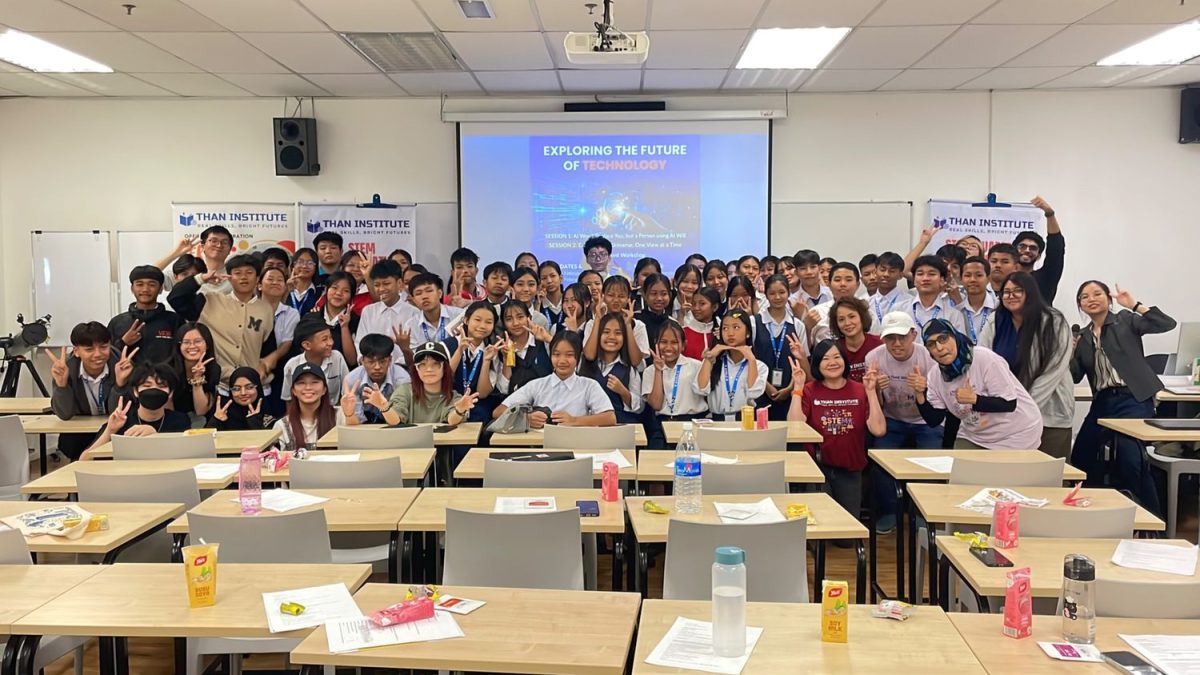
This February, we actualized this mission through a strategic collaboration with AIESEC. Together, we hosted a landmark two-day workshop titled “Exploring the Future of Technology” at the Lecture Theatre of Sunway University. The event was a convergence of industry expertise and youth leadership, designed to equip student volunteers with the critical skills needed to mentor and inspire others.
1. Strategic Partnership: Than Institute x AIESEC
2. The “Train the Trainer” Methodology
3. Session 1: Demystifying AI and Augmented Intelligence
4. Session 2: STEAM and the Spirit of Exploration
5. SDG 4: Ensuring Inclusive Quality Education
6. Industry Relevance: HRDC Claimable Training
7. Conclusion: Real Skills, Bright Futures
1. Strategic Partnership: Than Institute x AIESEC
Meaningful impact requires meaningful collaboration. When we set out to design a CSR program that would resonate with the youth of Malaysia, we looked for a partner that embodied leadership, energy, and a commitment to global betterment. AIESEC was the unequivocal choice.
As the world’s largest youth-run organization, AIESEC provides a unique platform for young people to explore their leadership potential. They understand the language of students. They know the anxieties young people face regarding their future careers, and they have the network to mobilize volunteers who are eager to make a difference. Conversely, Than Institute brings professional rigor, technical curriculum, and deep industry insights. We understand what employers are looking for because we train their workforce every day.
The synergy at Sunway University was palpable. By combining our resources, we created a program that was both technically sound and socially engaging. This partnership allowed us to bypass the “lecture” format and create a collaborative environment where students felt heard, valued, and empowered to take ownership of their learning journey. It represents a model of how the private sector and student organizations can work together to solve national challenges.
2. The “Train the Trainer” Methodology
One of the defining features of this workshop was its pedagogical approach. We were not simply teaching students for their own benefit; we were teaching them so they could teach others. The workshop manifesto explicitly stated our goal: “Equipping volunteers with foundational AI knowledge & practical teaching skills to inspire the next generation.”
This “Train the Trainer” model is the most sustainable form of educational CSR. The participants in the Lecture Theatre were volunteers who frequently engage in community outreach, visiting schools and underprivileged communities to mentor younger children. If we teach a child to use AI, we impact one life. But if we teach a volunteer how to explain AI, how to break down complex concepts into simple analogies, and how to facilitate a safe learning environment, we impact hundreds.
During the sessions, we focused heavily on communication skills. We taught volunteers how to answer difficult questions, how to manage a classroom dynamic, and how to spark curiosity in children who might be intimidated by technology. We are essentially building a fleet of ambassadors for the future of technology, ensuring the knowledge ripples outward far beyond the walls of the university. This multiplier effect is central to Than Institute’s philosophy of creating lasting social change.
3. Session 1: Demystifying AI and Augmented Intelligence
The first deep-dive session was titled “AI Won’t Replace You, but a Person using AI Will.” This title addresses the elephant in the room: Fear.
In the current media narrative, Artificial Intelligence is often painted as a looming threat—a force that will render human effort obsolete. For students preparing to enter the job market, this can be paralyzing. Our objective was to dismantle this fear and replace it with agency. We introduced the concept of “Augmented Intelligence”—the idea that technology is a force multiplier for human potential, not a substitute for it.
We guided the volunteers through the practical realities of the modern workplace:
The Human Element: We demonstrated that while AI can generate code or write text, it cannot provide context, empathy, or ethical judgment. We showed examples of where AI fails without human oversight, reinforcing the idea that the “pilot” is just as important as the “plane.”
Prompt Engineering as Communication: We introduced the concept that talking to an AI model is a skill, much like management. The ability to articulate clear goals, refine outputs, and iterate on ideas is a form of digital leadership. Volunteers learned how to structure prompts to get the best results, transforming the AI from a magic box into a predictable tool.
Automation of Drudgery: We showed how AI tools can handle repetitive data entry and administrative tasks. This was particularly impactful, as it showed students that AI can handle the “boring” parts of a job, freeing them up to focus on creative problem-solving and strategy. By the end of the session, the shift in mindset was visible. The students realized that adaptability is their greatest asset.
4. Session 2: STEAM and the Spirit of Exploration
While Session 1 focused on the digital realm, Session 2, titled “Exploring the Universe, One View at a Time,” expanded the horizon to the physical universe. This session was anchored in the STEAM framework—Science, Technology, Engineering, Arts, and Mathematics.
Why talk about space exploration in a tech workshop? Because curiosity is the engine of innovation. We used the theme of the universe to demonstrate data visualization and the scientific method. We explained how the beautiful images of distant galaxies are actually the result of massive data processing—the same kind of data processing used in business analytics.
For volunteers who work with children, space is an incredibly powerful “hook.” It captures the imagination instantly. By equipping volunteers with accurate scientific facts and the ability to explain how telescopes work, we gave them a toolkit to inspire a love for science in younger students. We emphasized that the “Arts” in STEAM are crucial; being able to visualize and communicate data is just as important as gathering it.
This session connected the dots between raw data (Science/Math) and human understanding (Arts). It encouraged the volunteers to look up from their screens and appreciate the vastness of the universe, reminding them that technology is ultimately a tool for exploration and understanding.
5. SDG 4: Ensuring Inclusive Quality Education
At Than Institute, our operations are strictly aligned with the United Nations Sustainable Development Goals (SDGs). This workshop was a direct and focused contribution to SDG 4: Quality Education.
Specifically, we are addressing Target 4.4, which aims to substantially increase the number of youth and adults who have relevant skills, including technical and vocational skills, for employment, decent jobs, and entrepreneurship. In Malaysia, as in many rapidly developing nations, the digital divide is a pressing issue. High-level training on topics like Generative AI, Robotics, and Data Science is often expensive and restricted to senior corporate professionals.
Democratizing Access: By providing this training pro bono to student volunteers, we are democratizing access to this knowledge. We are ensuring that financial barriers do not prevent motivated young leaders from understanding the tools that will shape their future. This is critical for social mobility.
Bridging the Skills Gap: Employers today are looking for “work-ready” graduates. They need individuals who can step into a role and immediately utilize modern digital tools. By aligning our workshop curriculum with current industry standards, we are helping to reduce youth unemployment. We are helping to build a workforce that is “future-proof,” reducing the anxiety that comes with technological disruption.
Lifelong Learning: Education does not stop at graduation. One of our key messages to the volunteers was that learning must be continuous. By introducing them to the fundamentals of AI now, we are giving them the confidence to continue learning as the technology evolves. We are planting the seeds for a culture of lifelong learning, which is the cornerstone of SDG 4.
6. Industry Relevance: HRDC Claimable Training
While our work with students is driven by social responsibility, our engagement with the corporate sector is driven by economic necessity. The principles we taught at Sunway University—adaptability, automation, and data literacy—are the exact same principles that define successful businesses in 2026.
Is your company keeping pace? Or are you relying on outdated workflows? Than Institute offers comprehensive, industry-grade corporate training programs that are 100% HRDC Claimable. We help Malaysian businesses transition from legacy systems to smart, AI-driven efficiency.
🚀 AI & Robotics Integration: Automate routine tasks & reduce error rates.
📊 Data-Driven Decision Making: Turn raw numbers into actionable strategy.
🤖 Generative AI for Business: Boost daily productivity immediately.
🎓 Customized Upskilling: Tailored specifically to your industry needs.
7. Conclusion: Real Skills, Bright Futures
The “Exploring the Future of Technology” workshop was more than just an event; it was a statement of intent. It demonstrated what is possible when the private sector actively invests in the potential of the youth.
We witnessed firsthand the hunger