
SDG 5 – Gender Equality and Its Benefits Toward STEM Education at Than Institute
SDG 8 – Decent Work and Economic Growth and Its Benefits Toward
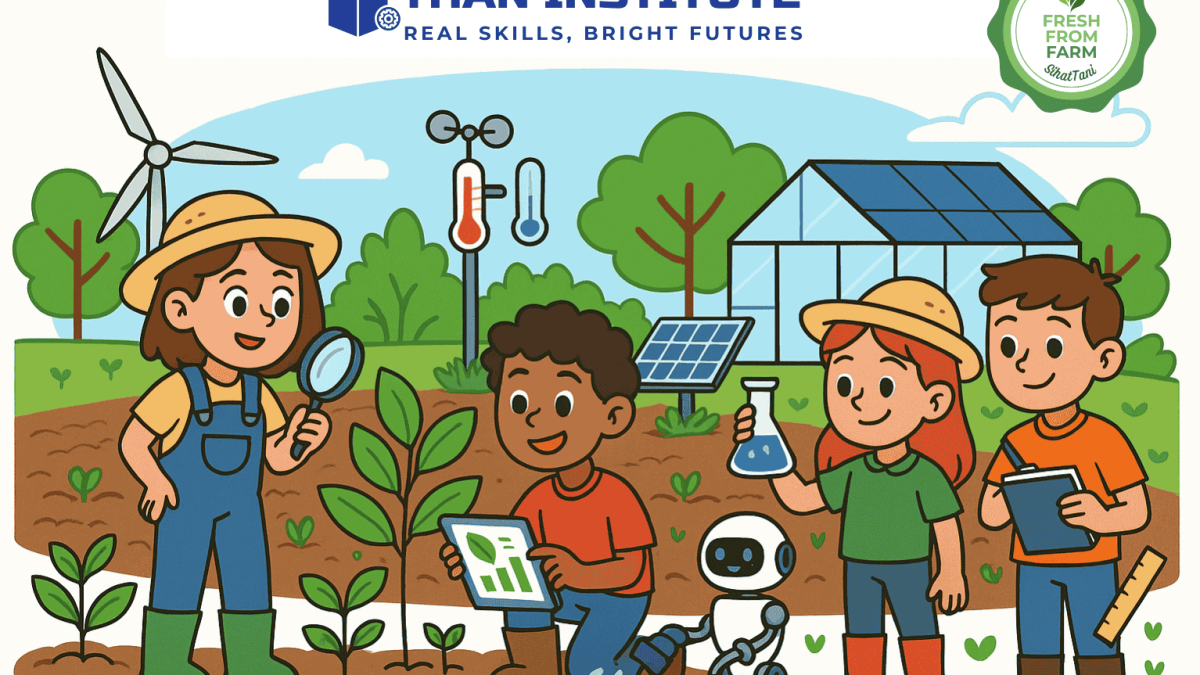
An in-depth guide by Than Institute on how science, technology, engineering, and mathematics are transforming modern farming.
1) Introduction: Why Agriculture Needs STEM
Agriculture remains the backbone of human civilization, yet the pressures of the twenty-first century—climate volatility,
land degradation, water scarcity, and rapid population growth—demand a fundamental reimagining of how we grow food.
STEM (science, technology, engineering, and mathematics) provides the frameworks, tools, and methods required to
make agriculture more resilient, efficient, and sustainable. Instead of relying solely on tradition, modern farms
integrate sensors, data models, biotechnology, and efficient design to balance productivity with ecological stewardship.
For young learners, agriculture becomes a living laboratory where classroom concepts translate into real solutions for
food security, environmental health, and community wellbeing.
Key Highlights
- STEM helps address climate risk, resource limits, and global food demand.
- Agriculture has shifted from tradition-only to data-driven, evidence-based practice.
- Students see agriculture as a dynamic innovation hub—not just a rural occupation.
2) The Role of Science in Modern Farming
Science underpins every modern breakthrough on the farm. In biology, plant genetics and microbiology inform how crops resist
pests and how beneficial soil microbes improve nutrient uptake. In chemistry, precise nutrient formulations and soil pH
management minimize waste and runoff while boosting yield. Environmental science guides decisions on crop selection, water
cycles, and biodiversity protection, ensuring farms work with ecosystems rather than against them. Methods such as
hydroponics, aquaponics, and vertical farming demonstrate how biological principles and chemical balances enable high-density
food production with minimal land, reduced water, and year-round consistency—even in urban settings.
- Biology: Plant genetics, beneficial microbes, integrated pest management.
- Chemistry: Nutrient solutions, soil pH control, safe inputs with lower environmental impact.
- Environmental science: Climate resilience, water cycles, ecosystem services, soil conservation.
- Innovations: Hydroponics, aquaponics, vertical farms for high yield with lower resources.
3) Technology and Smart Agriculture
Technology has ushered in the era of precision agriculture, where every intervention is measured and optimized.
Drones and satellite imagery reveal crop stress and soil variability that the human eye can’t detect. Internet-of-Things
(IoT) devices log soil moisture, leaf temperature, and nutrient levels in real time, enabling just-in-time irrigation and
fertigation. Artificial intelligence analyzes historical weather, disease patterns, and yield data to predict outcomes and
recommend actions that reduce risk and waste. In the classroom, these tools connect coding, robotics, and data science to a
tangible mission: grow more with less while protecting ecosystems.
- Drones/Remote sensing: Rapid field scouting, NDVI maps, early stress detection.
- IoT sensors: Automated alerts for irrigation and nutrient dosing to save water and inputs.
- AI & analytics: Yield prediction, disease detection, decision support dashboards.
- Automation/Robotics: Targeted weeding, precision planting, selective harvesting.
4) Engineering Innovations in Food Production
Engineering translates scientific insight into practical systems that scale. Efficient irrigation networks minimize loss
through drip lines, pressure control, and smart valves. Protected cultivation—greenhouses, shade houses, and climate
screens—extends growing seasons and stabilizes yields. Post-harvest engineering reduces spoilage with cold-chain design,
hygienic handling, and packaging innovations. Renewable energy systems—solar pumps, wind power, and biogas—decarbonize farm
operations and lower long-term costs. For students, building mini greenhouses or solar-powered fans turns abstract concepts
into hands-on prototypes and sparks entrepreneurial thinking.
- Irrigation: Drip, micro-sprinklers, automated valves for water conservation.
- Protected cultivation: Greenhouses and climate screens for stable, higher-quality yields.
- Post-harvest: Cold-chain design, hygienic processing, smart packaging to cut losses.
- Renewables: Solar/wind/biogas solutions for clean, reliable farm energy.
5) Mathematics in Crop Planning and Sustainability
Mathematics is the decision engine of modern farms. Statistical analyses compare varieties, quantify yield variability, and
validate what works in different microclimates. Optimization models balance costs, labor, water, and nutrients to meet
sustainability targets without sacrificing profitability. Forecasting methods turn weather and market data into plans for
planting schedules, harvest timing, and storage capacity. Visual analytics dashboards convert complex datasets into
understandable insights, empowering students to see how equations influence food output, input efficiency, and environmental
impact in the real world.
- Statistics: Variety trials, yield comparisons, confidence in decisions.
- Optimization: Least-cost nutrient plans, water budgets, labor scheduling.
- Forecasting: Weather-informed planting/harvest windows, demand projections.
- Data viz: Dashboards to translate field data into clear, actionable strategies.
6) Careers in STEM Agriculture for the Next Generation
Far beyond traditional roles, today’s agriculture offers high-impact, high-tech careers that blend purpose with innovation.
Agricultural data scientists transform sensor and satellite data into decisions. Precision farming engineers design the tools
and platforms that automate field operations. Biotech researchers breed resilient, nutrient-dense crops. Food sustainability
consultants help farms and supply chains meet environmental and social goals. Remote sensing analysts fuse space technology
with agronomy to monitor crops at regional and global scales. These pathways let students contribute meaningfully to food
security, climate action, and economic resilience.
- Agricultural Data Scientist
- Precision Farming Engineer
- Biotech Researcher (plant breeding, genomics)
- Food Sustainability Consultant
- Remote Sensing Analyst (satellite/drone imagery)
7) How Than Institute Prepares Students for an Agri-Tech Future
Than Institute embeds STEM Agriculture through project-based learning that emphasizes design, testing, and iteration.
Students prototype hydroponic systems, program moisture-sensing irrigation, and analyze growth data in spreadsheets and code.
Field exposure—farm visits, lab tours, and dialogues with agri-tech founders—connects classroom learning to real-world
innovation. Entrepreneurship modules guide learners from problem discovery to solution design and pitching, reframing farming
as a scalable technology and sustainability venture. By graduating with technical fluency, systems thinking, and business
awareness, students are prepared to lead in the agri-tech ecosystem.
Point-Form Takeaways
- Hands-on projects: Hydroponics, sensor-based irrigation, growth analytics.
- Real-world exposure: Modern farms, biotech labs, agri-tech startups.
- Entrepreneurship: Problem framing, prototyping, pitch readiness.
- Future-ready skills: Technical literacy, data fluency, sustainability mindset.
8) Conclusion: Planting Seeds of Innovation
STEM Agriculture equips the next generation to feed a growing world while protecting the planet. By uniting scientific
discovery, digital tools, engineered systems, and mathematical rigor, students learn to create farms that are productive,
resilient, and sustainable. Within Than Institute’s approach, every sensor readout, growth chart, and prototype greenhouse
becomes a step toward smarter food systems and stronger communities. The seeds we plant in the classroom today will
flourish as tomorrow’s solutions in fields, cities, and vertical farms worldwide.
- STEM turns agriculture into a smart, sustainable, data-driven industry.
- Students gain practical skills with real environmental and social impact.
- Than Institute nurtures innovators ready to lead in agri-tech.