
Future-Proofing Careers: How STEM Education Shapes Cybersecurity Leaders
Unlocking the Future: The Role of AI in Transforming STEM Education
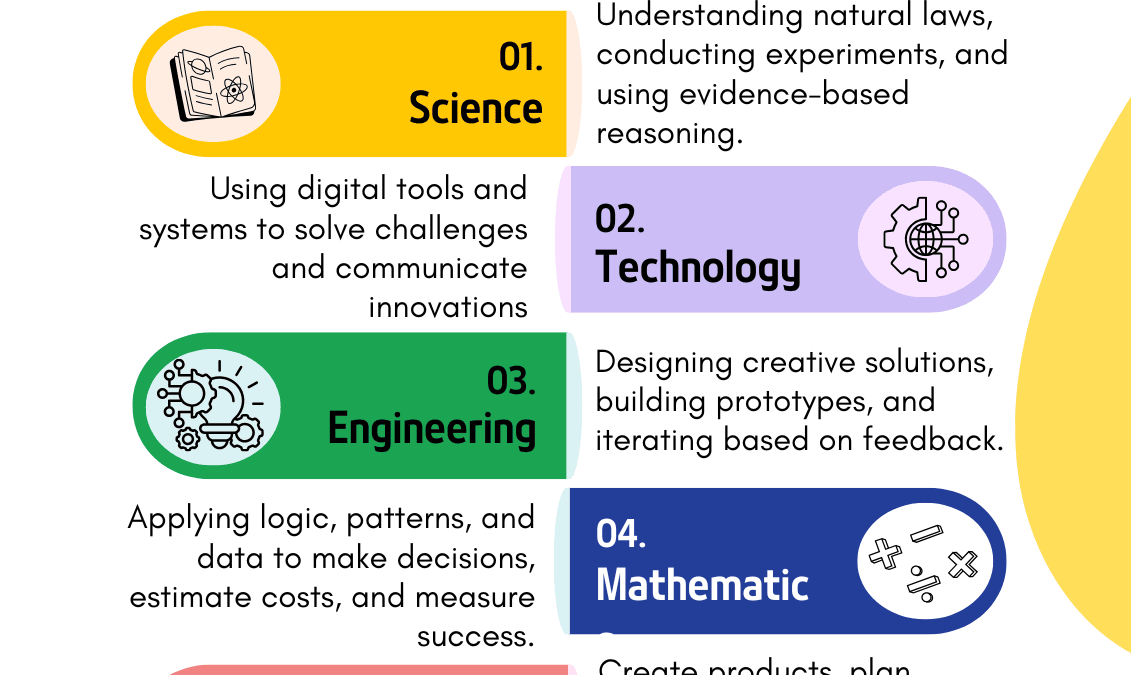
Based on Than Institute’s learning model: Science, Technology, Engineering, Mathematics + Entrepreneurship → Visionary Innovation.
Introduction: Why STEM Education and Entrepreneurship Matter
In a world defined by rapid change, STEM education equips learners with the analytical tools to understand problems, while entrepreneurship builds the courage to act on insights. The Than Institute’s “STEM Quartet + Entrepreneurship Framework” blends scientific inquiry, digital fluency, design thinking, and mathematical reasoning with market awareness and confident communication. Together, these pillars cultivate adaptable graduates who can test assumptions, build prototypes, measure impact, and pitch solutions. This approach goes beyond memorization; it develops creators who see constraints as launch pads for better ideas. When students practice evidence-based reasoning and opportunity spotting side by side, they become the kind of versatile contributors modern teams need.
- Key benefit: unites deep technical literacy with business-savvy action.
- Builds resilient mindsets for ambiguous, real-world challenges.
- Improves collaboration, communication, and leadership readiness.
- Turns classroom knowledge into community and market value.
The Power of the STEM Quartet
Science — Understanding Natural Laws
Science trains students to observe, hypothesize, and test. Learners explore natural laws, run experiments, and rely on evidence-based reasoning to separate signal from noise. In project contexts, this means defining variables, collecting clean data, and documenting results that teams can trust. By linking phenomena to models, students acquire a transferable habit: ask better questions, then let data guide decisions. That habit becomes invaluable when evaluating product features, sustainability claims, or health and safety considerations in future ventures.
- Builds rigorous thinking and ethical use of data.
- Improves research literacy and scientific communication.
- Supports responsible innovation and compliance.
Technology — Using Digital Tools to Create
Technology converts ideas into working systems. Students use digital tools, code, automation, and communication platforms to solve challenges and share outcomes. They learn how interfaces affect adoption, how data flows shape insights, and how security and privacy guardrails earn user trust. With this fluency, teams can move from a concept sketch to an interactive demo quickly, gathering feedback early and often. The result is faster iteration cycles and solutions that fit people’s needs.
- Enhances digital literacy and systems thinking.
- Enables rapid prototyping and iterative improvement.
- Strengthens collaboration with remote or cross-functional teams.
Engineering — Designing & Iterating Solutions
Engineering blends creativity with constraints. Learners frame problems, draft requirements, build prototypes, test them, and refine based on feedback. They apply patterns, trade-off analysis, and cost–benefit thinking to reach feasible designs. Through this lens, failure is data, not defeat. Students practice version control, documentation, and peer reviews—habits that make complex teamwork smoother and more transparent. As confidence grows, they can scale from classroom builds to real pilots.
- Promotes practical creativity and structured problem-solving.
- Instills quality, safety, and reliability standards.
- Teaches cost estimation and performance measurement.
Mathematics — The Language of Logic & Measurement
Mathematics is how ideas gain precision. Students use patterns, statistics, and modeling to make decisions, estimate budgets, and measure success. Quantitative literacy turns vague goals into trackable metrics—conversion rates, margins, confidence intervals, and error bars. By learning to test significance and forecast scenarios, students avoid guesswork and align teams on what truly moves the needle. Numbers become a shared narrative for design and business choices.
- Improves numeracy, forecasting, and risk assessment.
- Supports budget planning and ROI evaluation.
- Enables transparent, data-driven communication.
Adding Entrepreneurship: The Fifth Pillar
Entrepreneurship channels STEM capability into impact. Students create products, plan budgets, validate markets, and pitch ideas with confidence. They cultivate the courage to tackle big challenges head-on—even when the path is unclear. By interviewing users, mapping value propositions, and navigating feedback, they learn that customer insight is as critical as technical elegance. This synthesis of feasibility, desirability, and viability turns projects into solutions that people love and organizations can sustain.
- Develops leadership, storytelling, and stakeholder alignment.
- Builds resilience through iterative market testing.
- Encourages ethical, inclusive, and sustainable innovation.
Visionary Innovation: The Ultimate Goal
When STEM meets entrepreneurship, the outcome is Visionary Innovation—bold, evidence-driven ideas pursued with discipline. Students learn to challenge assumptions, embrace uncertainty, and set measurable milestones. They communicate complex concepts clearly, cultivate partnerships, and navigate constraints as design prompts. Most importantly, they see themselves as capable change-makers who can improve systems, communities, and markets through continuous learning and ethical action.
- Combines curiosity, courage, and accountability.
- Transforms prototypes into real-world pilots and ventures.
- Builds confident contributors ready for future careers.
Benefits of the STEM + Entrepreneurship Model
Integrating these pillars yields graduates who are technically fluent, opportunity-aware, and collaboration-ready. They can join engineering firms, launch startups, or innovate within healthcare, sustainability, and civic tech. Because they’ve practiced experimentation, feedback loops, and pitching, they transition smoothly from classroom to workplace. With shared vocabularies around experiments, metrics, prototypes, and value propositions, teams move faster and make better decisions.
- Higher engagement through hands-on, inquiry-based learning.
- Improved employability and adaptability across sectors.
- Stronger innovation capacity and measurable outcomes.
Real-World Applications
Who benefits: students, educators, and employers seeking versatile problem solvers. What changes: classes shift from passive lectures to project-based challenges tied to community needs. Where it works: schools, makerspaces, labs, and incubators. When to implement: from middle school through university and workforce reskilling. Why it matters: economies reward creativity, data literacy, and entrepreneurial drive. How to start: integrate small experiments—user interviews, simple prototypes, and metrics dashboards—then scale to capstone projects and real pilots.
- STEM entrepreneurs: green tech devices, telehealth apps, edtech tools.
- Engineering innovators: smart infrastructure and assistive devices.
- Math-driven analysts: cost models and demand forecasting.
- Science communicators: evidence translation for public good.
Comparison Tables
Traditional Education vs. STEM+Entrepreneurship Framework
| Dimension | Traditional Education | STEM + Entrepreneurship |
|---|---|---|
| Learning Approach | Lecture-heavy, recall-focused | Hands-on, inquiry-based, iterative |
| Skills Developed | Memorization, isolated knowledge | Critical thinking, creativity, teamwork |
| Career Readiness | Limited exposure to real problems | Portfolio projects, market validation, pitching |
| Innovation Capacity | Low to moderate | High and measurable |
| Confidence Level | Average | Empowered, visionary, data-driven |
Level of STEM Integration (Low / Normal / High)
| Integration Level | Characteristics | Expected Outcome |
|---|---|---|
| Low | Textbook theory with few projects | Limited engagement and transfer |
| Normal | Occasional projects and tool use | Moderate creativity and collaboration |
| High (Than Institute Framework) | Full integration with Entrepreneurship and validation cycles | Exceptional leadership, adaptability, and Visionary Innovation |