
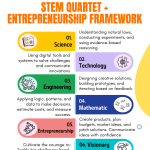
The STEM Quartet + Entrepreneurship Framework
AI in the Classroom: Revolutionizing STEM Learning Experiences
In recent years, artificial intelligence (AI) has emerged as a transformative force across various sectors, and education is no exception. Particularly in the realms of science, technology, engineering, and mathematics (STEM), AI is revolutionizing the learning experience for educators and students alike. By leveraging AI technologies, educational institutions can foster a more personalized, engaging, and effective learning environment, thus unlocking new possibilities for future generations.
AI-Powered Personalized Learning
One of the most significant advancements attributed to AI in STEM education is the emergence of personalized learning. AI can analyze vast amounts of data to identify individual student strengths, weaknesses, and learning preferences. This personalized approach tailors educational content to meet each student’s unique needs, ensuring that no learner is left behind.
For instance, AI algorithms can adjust lesson plans and problem-solving exercises based on a student’s performance in real-time. If a student struggles with a particular concept, the AI can provide additional resources, such as tutorials or interactive simulations, tailored specifically to address those challenges. This adaptability not only enhances comprehension but also fosters a growth mindset among students, encouraging them to tackle difficult subjects with confidence.
Enhanced Engagement Through Interactive Learning Tools
AI technology is also enhancing student engagement through interactive learning tools. Tools such as AI-driven simulations and virtual labs provide students with hands-on experiences that traditional learning methods may lack. For example, in fields like physics or chemistry, students can conduct experiments in a virtual environment, allowing them to grasp complex concepts without the constraints and dangers of real-world labs.
Moreover, AI-enabled chatbots can offer 24/7 support, answering students’ queries and guiding them through challenging topics. This constant support not only helps students to learn at their own pace but also alleviates the pressure on educators, who can focus on deeper instructional strategies rather than routine questions.
AI as a Tool for Educators
Beyond its impact on students, AI also serves as a potent tool for educators. By automating administrative tasks, such as grading and attendance tracking, AI allows teachers to dedicate more time to what truly matters: instruction and student interaction. Educators can leverage AI analytics to gain insights into classroom dynamics, helping them adjust their teaching strategies in real-time and improve overall student outcomes.
Furthermore, AI can assist in professional development by curating relevant resources and recommending training programs tailored to individual teachers’ needs. By bridging the gap between professional growth and effective teaching practices, AI empowers educators to stay abreast of new trends and methodologies in STEM education.
Addressing the Skills Gap
In a rapidly changing job market characterized by technological advancements, there is a notable skills gap in STEM fields. AI plays a crucial role in preparing students for the workforce by equipping them with essential skills and competencies. Through interactive and practical learning experiences powered by AI, students can develop critical thinking, problem-solving, and collaboration skills—key attributes sought by employers.
Moreover, AI can help identify emerging trends in various industries, allowing educational institutions to adapt curricula accordingly. This alignment ensures that students are not only prepared for today’s job market but are also future-ready to face the challenges of tomorrow.
Equity in Access to Education
AI has the potential to promote equity in STEM education by making high-quality learning resources accessible to all students, regardless of their geographical location or socioeconomic status. Online platforms powered by AI can deliver personalized content to learners in remote areas, bridging the gap between urban and rural education.
In addition, AI allows for the creation of multilingual educational resources, breaking down language barriers that often hinder learning. Such inclusivity fosters an environment where all students have the opportunity to thrive, ultimately driving diversity in STEM fields.
Challenges and Ethical Considerations
Despite the numerous benefits of integrating AI into STEM education, there are challenges and ethical considerations to address. Issues such as data privacy, algorithmic bias, and the digital divide must be navigated carefully to ensure that AI serves as a force for good in education. Stakeholders, including educators, policymakers, and technologists, must collaborate to establish guidelines and frameworks that protect the interests of all students.
The Future of STEM Education with AI
The integration of AI in STEM education is not merely a trend; it is a transformative shift that is set to redefine the educational landscape. As AI technology continues to evolve, its applications will expand, offering new opportunities for enhancing learning outcomes and preparing students for a dynamic future.
In conclusion, embracing AI in STEM education can unlock the potential of both learners and educators. By focusing on personalization, engagement, and equity, we can harness the power of AI to foster a generation of innovators, thinkers, and problem-solvers ready to tackle the challenges of tomorrow.
FAQs
1. How does AI enhance personalized learning?
AI enhances personalized learning by analyzing student data to identify individual learning styles, strengths, and weaknesses. This allows for tailored content that meets each student’s needs.
2. What are some examples of AI tools in STEM education?
Examples include AI-driven simulations, virtual labs, and chatbots that provide instant feedback and support to students.
3. Can AI replace teachers in the classroom?
No, AI is designed to assist teachers rather than replace them. It automates administrative tasks and provides insights that enable educators to focus more on teaching.
4. How does AI help address the skills gap in STEM?
AI helps address the skills gap by equipping students with critical competencies and adapting curricula to align with emerging industry trends.
5. What ethical considerations surround AI in education?
Ethical considerations include data privacy, algorithmic bias, and ensuring equitable access to resources for all students.